Tax Devolution Between Centre and States Explained
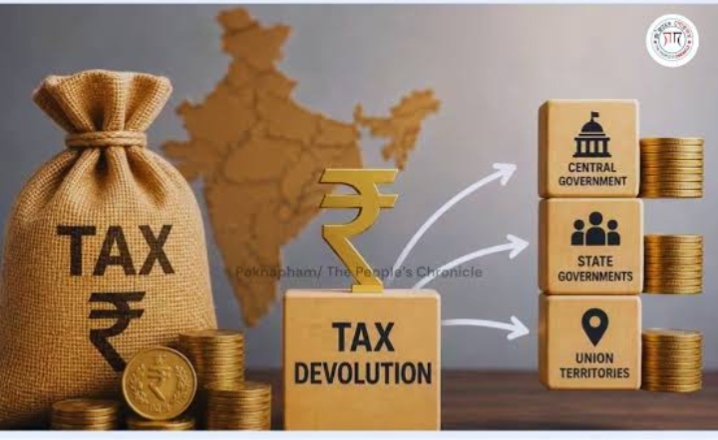
Tax devolution refers to how the Central Government distributes a share of its tax revenue among the State Governments, based on the recommendations and guidelines of the Finance Commission established under Article 280 of the Indian Constitution.

What is Vertical Devolution?
Vertical devolution refers to the portion of the Centre’s tax revenue transferred to all the states.
Divisible Pool: The Central Government collects taxes and excludes cesses, surcharges, and the costs involved in tax collection before determining the divisible pool.
States’ Share: The 16th Finance Commission has retained the states’ share at 41%, the same level recommended by the 15th Finance Commission. In simple terms, states receive ₹41 for every ₹100 available in the divisible pool.
What is Horizontal Devolution?
Horizontal devolution refers to the method used to distribute the states’ overall 41% share among individual states. The 16th Finance Commission has assigned specific weights to different criteria for determining each state’s share.
Income Distance (Per Capita GSDP): 42.5% weight. States with lower per capita income receive a greater share to promote equitable distribution.
Population (2011 Census): 17.5% weight. The population figures from the 2011 Census are used as one of the criteria for allocation.
Demographic Performance: 10% weight. This criterion provides an advantage to states that have made progress in controlling population growth.
Area: 10% weight. The geographical size of a state is considered while determining its share.
Forest and Ecology: 10% weight. States with significant forest cover and better ecological performance receive greater consideration.
Contribution to GDP: 10% weight. This is a new criterion that recognises a state’s contribution to national economic output and replaces the earlier tax-effort criterion.
What is Tax Devolution?
Meaning:
Tax devolution is the constitutional arrangement through which tax revenue is shared between the Union Government and the State Governments. It ensures that the proceeds from specified taxes are distributed between the Union and the states in a fair and balanced manner.
Under Article 280(3)(a) of the Indian Constitution, the Finance Commission is responsible for recommending how the net proceeds of taxes should be divided between the Union and the states.
Key Recommendations of the 15th Finance Commission:
States’ Share in Central Taxes (Vertical Devolution):
For the 2021–26 period, the Finance Commission recommended that states receive 41% of the divisible pool of central taxes, maintaining the same share as in 2020–21.
This was a reduction from the 42% share recommended by the 14th Finance Commission for the 2015–20 period.
The 1 percentage-point reduction was intended to account for the resource requirements of the newly created Union Territories of Jammu and Kashmir and Ladakh, which were to be met from the Centre’s share.
Horizontal Devolution (Distribution Among States):
The 15th Finance Commission proposed a formula for distributing the states’ share of taxes. It assigned 45% weight to income, 15% each to population and area, 12.5% to demographic performance, 10% to forest and ecology, and 2.5% to tax and fiscal efforts.
Revenue Deficit Grants to States:
Revenue deficit represents the gap between a state’s revenue expenditure and its revenue receipts, including both tax and non-tax revenues.
The Commission recommended post-devolution revenue deficit grants of approximately ₹3 trillion to states over the five years ending in FY 2025–26.
Performance-Based Incentives and Grants to States:
The Commission’s performance-linked grants broadly covered four major areas.
The first area was the social sector, with particular emphasis on improving health and education.
The second focused on the rural economy, especially agriculture and the upkeep of rural roads.
The rural economy is particularly important to India because it accounts for around two-thirds of the country’s population, 70% of its workforce, and 46% of national income.
Governance and Administrative Reforms:
The third area focuses on strengthening governance and administrative systems. Grants have been proposed for areas such as the judiciary, statistical systems, aspirational districts, and aspirational blocks.
Power Sector Reforms:
The fourth area introduces a performance-linked incentive framework for the power sector. Rather than being provided as a direct grant, this incentive allows states to access an additional borrowing facility, subject to their performance.
Grants to Local Governments
The Finance Commission has recommended grants for municipal services and local government institutions, along with performance-based funding for developing new cities and improving healthcare services at the local level.
For urban local bodies, basic grants are proposed only for cities and towns with populations below one million.
In the case of million-plus cities, the entire grant allocation is performance-based and provided through the Million-Plus Cities Challenge Fund (MCF).
The amount available under the MCF depends on how well these cities perform in improving air quality and achieving service-level standards for urban drinking water, sanitation, and solid waste management.
What is the Role of the Finance Commission in Maintaining Fiscal Federalism?
Sharing of Tax Revenue:
The Finance Commission recommends how the net tax proceeds should be divided between the Union Government and the State Governments.
This mechanism promotes a fair and balanced distribution of tax revenue, while considering the varying financial resources and expenditure needs of different states.
Distribution of Resources Among States:
The Finance Commission lays down the principles for providing grants-in-aid to states that need additional financial support.
It examines the fiscal requirements of individual states and recommends appropriate measures for transferring resources from the Consolidated Funds of the States.
Strengthening Local Governments:
The Finance Commission recommends measures to increase the resources available in a state’s Consolidated Fund so that these funds can help strengthen Panchayats and Municipalities.
Cooperative Federalism:
The Finance Commission follows a consultative and inclusive approach, involving different levels of government in its deliberations and thereby strengthening the spirit of cooperative federalism.
It holds discussions with the Union Government, State Governments, and other relevant stakeholders to obtain their views and incorporate diverse perspectives into the decision-making process.
Frequently Asked Questions (FAQs)
1. What is tax devolution between the Centre and states?
Tax devolution is the constitutional process through which a portion of the Union Government’s tax revenue is shared with State Governments. The Finance Commission recommends how this revenue should be distributed.
2. Which Article of the Constitution deals with tax devolution?
Article 280 provides for the Finance Commission, which recommends the distribution of the net proceeds of certain taxes between the Union and the states and among the states themselves.
3. What is vertical devolution?
Vertical devolution refers to the division of the divisible pool of central taxes between the Union Government and all State Governments collectively.
4. What is horizontal devolution?
Horizontal devolution determines how the states’ overall share of central taxes is distributed among individual states based on criteria recommended by the Finance Commission.
5. What is the divisible pool of central taxes?
The divisible pool generally consists of the net proceeds of Union taxes that are shareable with states. Cesses and surcharges are generally outside this pool.
6. What percentage of central taxes do states receive?
For the 2021–26 period, the 15th Finance Commission recommended 41% of the divisible pool for states. The 16th Finance Commission has also retained the states’ share at 41% for 2026–31.
7. Who decides the share of taxes given to states?
The Finance Commission of India, a constitutional body established under Article 280, recommends the states’ share and the principles for distributing it.
8. What is the difference between vertical and horizontal devolution?
Vertical devolution determines the share of central tax revenue going to all states together, whereas horizontal devolution decides how that share is divided among individual states.
9. Why is tax devolution important for fiscal federalism?
Tax devolution helps reduce differences in the financial capacity of states and enables them to fund essential public services. It also strengthens financial relations between the Centre and the states.
10. What factors are considered in horizontal tax devolution?
The Finance Commission considers factors such as income distance, population, demographic performance, area, forest and ecology, and contribution to GDP, with specific weights assigned to each criterion.