NITI Aayog's Role in India's Economic Development
NITI Aayog serves as the Government of India's central policy think tank, supporting national development by promoting strategic planning, strengthening cooperation between the Centre and states, and encouraging research- and evidence-based governance.
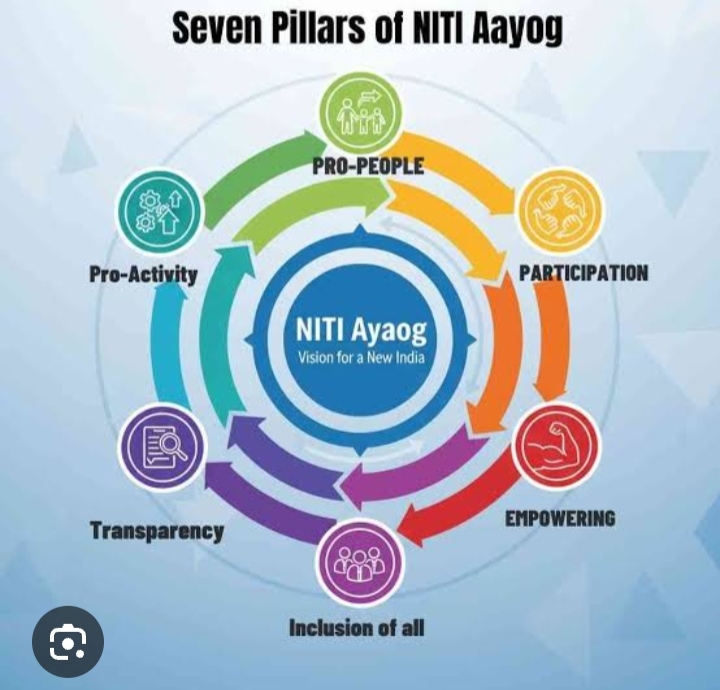
Core Roles and Functions
Policy Formulation: NITI Aayog develops long-term plans and policies for India's economic and social progress, covering important areas such as agriculture, infrastructure, healthcare, and other sectors.
Promoting Cooperative Federalism: It provides a platform for state governments and Union Territories to work with the Central Government on national development goals. This approach is more collaborative than the centralized, top-down system followed by the former Planning Commission.
Monitoring and Evaluation: NITI Aayog reviews the progress and results of major government schemes and programmes. It uses data and feedback to identify shortcomings and suggest necessary improvements during implementation.
Encouraging Innovation and Entrepreneurship: Through programmes such as the Atal Innovation Mission, NITI Aayog supports innovation, entrepreneurship, startups, and the development of new technologies in India.
Implementation of SDGs: It plays an important role in implementing the Sustainable Development Goals (SDGs) in India and monitors their progress across different states and Union Territories through various performance-based indices.-+
NITI Aayog is the leading policy think tank of the Government of India, responsible for providing policy guidance and strategic inputs for the country’s development. It was established on 1 January 2015 through a resolution passed by the Union Cabinet. The institution prepares long-term strategies, policies, and programmes for the Government and also provides technical and strategic support to the Central Government, State Governments, and Union Territories. Another important role of NITI Aayog is to strengthen cooperative federalism by encouraging the Centre, States, and Union Territories to work together towards achieving common national development goals.
The National Institution for Transforming India (NITI Aayog) came into existence on 1 January 2015, replacing the Planning Commission. It was introduced to bring a more flexible, participatory, and decentralized approach to India’s development planning. Rather than following the centralized planning system of the Planning Commission, NITI Aayog works as a policy think tank and gives greater importance to cooperative federalism, allowing states to participate actively in the country’s development process.
NITI Aayog contributes to India’s long-term economic development by providing strategic advice, developing policy frameworks, encouraging reforms, and supporting evidence-based decision-making. It works with the Central Government, states, and Union Territories to identify development priorities and formulate suitable strategies. It also reviews major government programmes and assesses their performance so that gaps can be identified and improvements can be made.
The organisation focuses on several important areas, including agriculture, infrastructure, industry, healthcare, education, technology, and the digital economy. Its emphasis on measurable outcomes, performance indicators, and effective use of resources helps improve transparency and accountability in government programmes. By encouraging outcome-oriented planning, NITI Aayog seeks to ensure that development policies produce tangible benefits for citizens.
Another important area of its work is the promotion of innovation and entrepreneurship. Through initiatives such as the Atal Innovation Mission, along with support for start-ups and emerging technologies, NITI Aayog encourages new ideas and strengthens India’s capacity to compete in the global economy. It also focuses on wider socio-economic issues, including poverty reduction, employment, skill development, and social inclusion.
Overall, NITI Aayog acts as an important institution for shaping India’s development priorities. Through policy coordination, cooperation between the Centre and states, reform-oriented recommendations, innovation, and strategic partnerships, it supports the goal of building a sustainable, resilient, self-reliant, and globally competitive Indian economy.
NITI Lectures: Transforming India
NITI Aayog introduced the “NITI Lectures: Transforming India” series following an initiative suggested by Prime Minister Narendra Modi. The programme was designed to bring internationally recognised policymakers, experts, and administrators to India so that they could share their experiences and perspectives on policymaking, administration, and good governance with their Indian counterparts.
The lecture series began with Tharman Shanmugaratnam, who was serving as Deputy Prime Minister of Singapore. He delivered the inaugural lecture, titled “India and the Global Economy,” at Vigyan Bhavan in New Delhi. The Prime Minister highlighted the purpose of the initiative and explained that India should aim for rapid transformation rather than gradual change.
State Statistics Handbook
On 31 August 2017, NITI Aayog introduced the State Statistics Handbook, bringing together important statistical information from different sectors for all Indian States and Union Territories. Earlier, data relating to various key indicators was spread across multiple sources, making it difficult to access in one place. The handbook addressed this issue by providing a single, consolidated source of essential state-level statistics, making it easier to study and compare development-related data.
IndiaChain and IndiaStack
One of the proposed initiatives of NITI Aayog involves connecting IndiaChain with IndiaStack, the digital infrastructure associated with services such as Aadhaar. The proposed blockchain-based system is intended to make contract execution more efficient, reduce the possibility of fraudulent transactions, and improve the delivery of government subsidies to farmers. It can also serve as a foundation for creating a broader system for maintaining digital records and delivering public services more effectively.
Job Portal for Migrant Workers
During the nationwide lockdown, many workers returned to their native states after losing employment opportunities in cities. To help address this issue, NITI Aayog worked on developing a job portal that could bring employers and returning workers onto a common platform. The proposed portal was intended to help workers find suitable employment opportunities closer to their home regions.
Role and Functions of NITI Aayog
NITI Aayog was established to take the place of the Planning Commission and introduce a more modern approach to economic and social planning in India. Compared with the earlier system, NITI Aayog follows a more flexible and collaborative model that can respond to changing economic, social, and environmental conditions.
The major functions of NITI Aayog include:
Policy Formulation: NITI Aayog offers strategic guidance and technical expertise to both the Central and State Governments on important areas such as agriculture, healthcare, education, infrastructure, energy, and environmental protection.
Monitoring and Evaluation: It reviews the progress of government schemes, programmes, and policies and assesses whether they are achieving their intended objectives. Based on its findings, NITI Aayog provides suggestions and feedback to improve the effectiveness and implementation of these initiatives.
Research and Analysis: NITI Aayog studies a wide range of economic and developmental matters and uses the findings to provide practical, evidence-based suggestions to the government for better policymaking.
Capacity Building: It works to strengthen the skills and capabilities of government officials and other stakeholders so that they can implement policies and programmes more efficiently and achieve better results.
Impact of NITI Aayog on India’s Development Agenda
Since its establishment, NITI Aayog has played an important role in shaping India’s development priorities and supporting the implementation of various government policies. Some of its major contributions include:
Strengthening Policy Formulation: NITI Aayog has contributed research, data, and evidence-based suggestions to help the government design more effective policies and improve their implementation.
Promoting Innovation and Entrepreneurship: Through initiatives such as the Atal Innovation Mission, NITI Aayog has encouraged young innovators, entrepreneurs, and start-ups. These efforts have helped create an environment that supports new ideas, technological development, and entrepreneurship across the country.
Strengthening Digital Infrastructure: NITI Aayog has contributed to the Digital India programme by supporting the development of digital systems that make government services more accessible, convenient, and efficient for citizens.
Greater Emphasis on Healthcare: The National Health Stack was proposed as a digital framework for the healthcare sector. It aims to improve the way health-related services and information are managed and delivered, thereby supporting greater efficiency and accessibility in healthcare.
Along with these initiatives, NITI Aayog has made an important contribution to strengthening cooperative federalism in India. It provides opportunities for the Central and State Governments to work together, exchange ideas, and coordinate their efforts. This collaborative approach has supported the smoother implementation of various government programmes, policies, and development initiatives.
Although NITI Aayog has faced certain criticisms, its contribution to India’s development process remains important. The organisation follows a flexible approach that enables it to respond to changing economic, social, and developmental requirements. As India encounters emerging challenges and explores new opportunities, NITI Aayog is expected to continue playing an important part in setting development priorities and supporting the country’s long-term growth.
FAQs: NITI Aayog's Role in India's Economic Development
1. What is NITI Aayog?
NITI Aayog, or the National Institution for Transforming India, is the Government of India’s premier public policy think tank. It provides strategic and technical advice to support economic and social development.
2. When was NITI Aayog established?
NITI Aayog was established on 1 January 2015, replacing the Planning Commission.
3. What is the main objective of NITI Aayog?
Its main objective is to support sustainable, inclusive, and balanced economic development through strategic policymaking, innovation, evidence-based planning, and cooperation between the Centre and States.
4. How does NITI Aayog contribute to economic development?
It contributes by developing policy strategies, conducting research, monitoring government programmes, promoting innovation, supporting reforms, and providing recommendations to improve development outcomes.
5. How does NITI Aayog promote cooperative federalism?
NITI Aayog encourages the Central Government, State Governments, and Union Territories to work together in planning and implementing development policies according to their specific needs and priorities.
6. What is the role of NITI Aayog in policy formulation?
It provides research-based and technical inputs to the government on areas such as agriculture, infrastructure, healthcare, education, industry, energy, and digital development.
7. What role does NITI Aayog play in monitoring government schemes?
NITI Aayog evaluates the progress and outcomes of important government programmes. Its assessments help identify implementation gaps and suggest measures for improving efficiency and effectiveness.
8. How does NITI Aayog promote innovation and entrepreneurship?
Through initiatives such as the Atal Innovation Mission, it encourages innovation, entrepreneurship, start-ups, incubation, and the development of new technologies.
9. What is the role of NITI Aayog in sustainable development?
NITI Aayog supports sustainable development by incorporating environmental, social, and economic considerations into policy planning and by coordinating India's progress towards the Sustainable Development Goals (SDGs).
10. How does NITI Aayog support agriculture?
It provides policy recommendations and promotes reforms aimed at improving agricultural productivity, farmers’ incomes, rural development, technology adoption, and agricultural infrastructure.