India at 80: The Rise of a Polarizing Superpower and the Great Indian Wallet Shift
The 80-Year Pivot: A Nation Recalibrated
On August 15, 1947, India inherited a fractured landscape defined by pervasive scarcity. The promise of freedom was visceral, but the material reality was grim: literacy rates were in the single digits, and between 70% to 80% of the population lived below the poverty line. For the average family, independence was less a geopolitical abstraction and more a desperate hope for a better material life.
Fast forward to 2026. As the tricolour rises to mark the 80th Independence Day, the narrative has pivoted from survival to "Viksit Bharat" (Developed India) ambitions. We are no longer a nation just trying to reach the "starting line." Instead, a population of 1.4 billion is fundamentally recalibrating its identity—shifting from a culture of saving for security to investing for wealth, and from a defensive strategic posture to a formidable projection of hard power. From the "Lakhpati Didi" initiative to the elite tech corridors, India is transitioning from a state of scarcity to a landscape of unprecedented choice.
The SUV Revolution: When Aspiration Moved Beyond the Plate
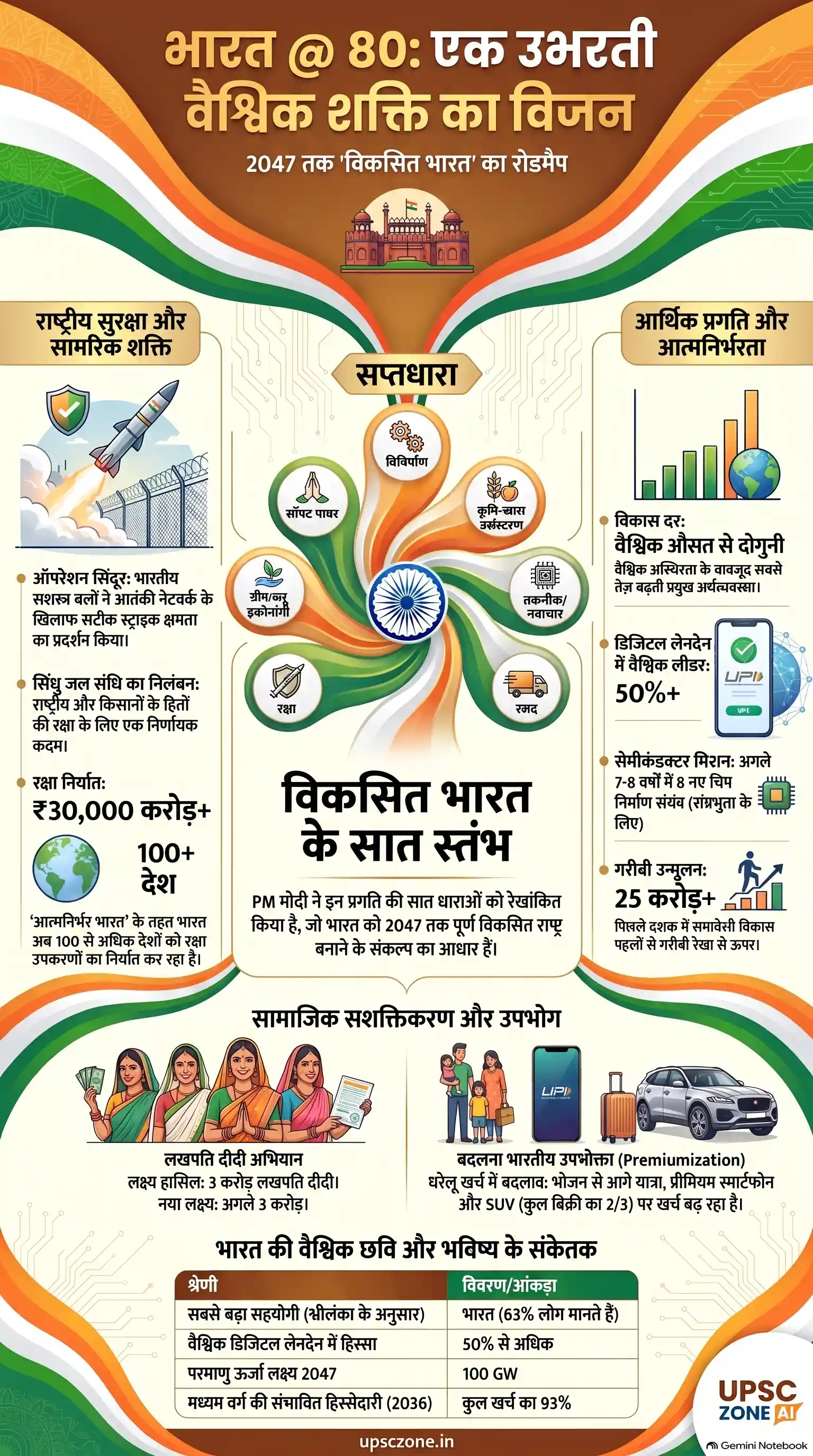
The most visible marker of India’s evolution is the death of the "budget" mindset. We are witnessing a shift from "Roti, Kapda, aur Makaan" (Food, Clothing, and Shelter) toward a era of selective premiumization. Data from the 2023-24 Household Consumption Expenditure Survey reveals that food’s share of the budget is shrinking—now 47% in rural areas and 40% in urban centers—leaving more for lifestyle choices.
The rural heartland is no longer just a "vote bank"; it has become a "consumer force." The economic divide is narrowing, with the rural-urban spending gap shrinking to ~70% in 2023-24. Nowhere is this clearer than in the driveway. SUVs now account for two-thirds of all passenger vehicle sales, up from less than a third a decade ago. Indian consumers are leveraging a $70 billion used-car market to trade up, choosing status and experience over the entry-level hatchbacks of yesteryear.
"Aspiration today is less about purchasing power and more about perceived possibility. Consumption is no longer organised around necessity; it is increasingly shaped by preference." — Poonam Upadhyay, Director at Crisil Ratings
Digital Dominance: Civic Tech and the New Identity
India’s digital infrastructure has achieved a scale that is effectively a global anomaly. The nation now accounts for over half of the world’s real-time digital transactions. But in 2026, this digital backbone is moving beyond payments to define the very social contract between the citizen and the state.
This is best exemplified by the Digital Census. Rather than a top-down bureaucratic exercise, it has become a movement of "civic tech." The Prime Minister’s call for the youth to contribute "1-2 hours" to ensure an error-free digital record represents a new form of national service. It is a recalibration of identity where 140 crore voices are documented in an inclusive, high-tech ledger, ensuring that "Viksit Bharat" is built on data, not just dreams.
Operation Sindoor: Hard Power and Strategic Autonomy
The 80th year marks India’s arrival as a "formidable military power," ranked among the top four globally. The commissioning of the nuclear-powered ballistic missile submarine INS Aridhaman in 2026 has solidified the nation’s nuclear triad and second-strike capability.
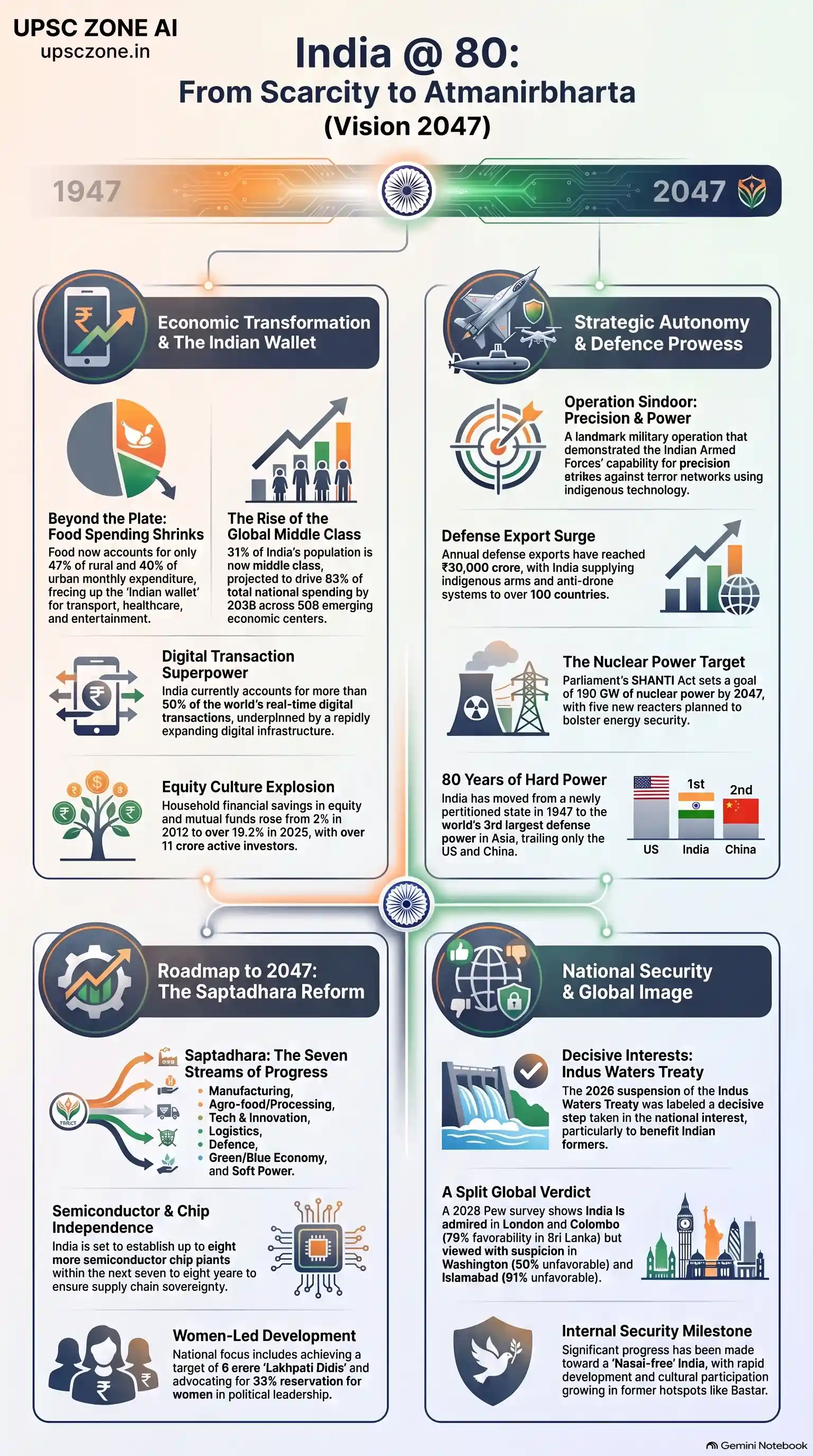
The demonstration of this new muscle came with "Operation Sindoor," a masterclass in indigenous precision-strike capabilities against terror networks. This is the fruit of a deliberate structural shift: India has transitioned from a top arms importer to a defence manufacturer exporting to over 100 countries. With defence exports hitting ₹30,000 crore, "Aatmanirbharta" is no longer a slogan; it is a ledger of hard power.
The Decisive Diplomatic Shift: Blood and Water
In a bold departure from historical policy, India’s suspension of the Indus Waters Treaty serves as a counter-intuitive masterstroke of strategic autonomy. Framed as a "decisive step in the national interest," the move leverages resource control to protect the domestic farming community.
This policy signals a hardening of India’s strategic posture. By explicitly adopting the doctrine that "blood and water cannot flow together," New Delhi is signaling to its neighbors and the world that it will no longer allow legacy treaties to supersede its current security requirements. It is an exercise of resource leverage that matches its growing military weight.
A Split Verdict: The Paradox of Global Image (India at 80)
India’s rise has made it too consequential to be viewed mildly. According to the 2026 Pew Research Center survey across 36 countries, India has become a "polarizing" superpower, with reputation often filtered through the lens of local regional interests:
High Warmth:
Sri Lanka: 79% (highest recorded, seen as a security guarantor).
United Kingdom: 71%.
Germany: 63% (A significant jump from 47% in 2023, suggesting a successful "de-risking" of India's image in Europe).
Growing Friction:
The United States: 45% favorable vs 50% unfavorable (a cooling trend reflecting partisan splits).
Pakistan: 7% favorable (predictably lopsided).
This "split verdict" is the price of strategic autonomy. By balancing the Quad with BRICS and the SCO, India avoids being a "junior partner" to any bloc, even if it results in mixed reviews from global partisans.
The Unity Challenge: The Vande Mataram Debate
Internal cohesion remains the most sensitive site of contestation. The "Prevention of Insults to National Honour (Amendment) Act, 2026," which mandates all six stanzas of Vande Mataram, has sparked a fierce debate over majoritarian nationhood versus civic, inclusive ideals.
While proponents see it as a reclamation of national honor, critics argue that moving beyond the first two stanzas—secularized during the freedom movement—portrays the nation through a specific religious lens that risks fracturing the "unity in diversity" essential to a multicultural Republic.
"The imposition of the song is an assault on national cohesion and the inclusive character of the Constitution. As we celebrate independence, we must dedicate ourselves to ever-increasing unity of our diverse people, not schism." — Economic and Political Weekly Editorial
From Savings to Wealth: The New Financial Mindset
The Indian "wallet" has undergone a psychological revolution. For decades, security meant bank deposits and gold. Today, the middle class—now 31% of the population and spreading rapidly into Tier-II and Tier-III cities—is chasing wealth through equity.
Monthly Systematic Investment Plan (SIP) contributions have hit a record ₹28,000 crore. The investor base has exploded from 3 crore in 2020 to over 11 crore in 2025. This represents a pivot from "saving for security" to "investing for wealth," as households build portfolios that are increasingly influenced by global markets and dollar-priced assets.
Conclusion: The Saptadhara Vision (India At 80)
India’s journey from the scarcity of 1947 to the 80th anniversary is anchored by the "Saptadhara"—the seven visions of power: manufacturing, agro-food production, technology and innovation, logistics, defence, the green/blue economy, and soft power.
The achievement is staggering: 25 crore people lifted out of poverty in a single decade and a target of 6 crore "Lakhpati Didis" within reach. However, as the nation looks toward its centenary, the central question remains: Can India’s burgeoning "hard power" and the increased "choice" of its consumers successfully harmonize with the internal "unity in diversity" that the constitutional Republic was designed to protect? The strength of the next decade will be measured by whether India’s power is used to enforce a single narrative or to empower every one of its 140 crore voices.