5 Surprising Truths About How We Build the Story of Us
History is often presented to us as a cemetery of facts—a static, dusty archive of names and dates to be memorized and filed away. But the very word "history" betrays this perception. Derived from the Greek historia, it does not mean "a record"; it means "inquiry" or "investigation." History is not a noun; it is a verb. It is an active, ongoing detective story where we serve as both the investigators and the subjects of the investigation.
To understand our own identity, we must recognize that the "archaeological record" and the "historical method" are far more dynamic—and occasionally counter-intuitive—than they appear in any textbook. Below are five revelations that change how we see the story of us.
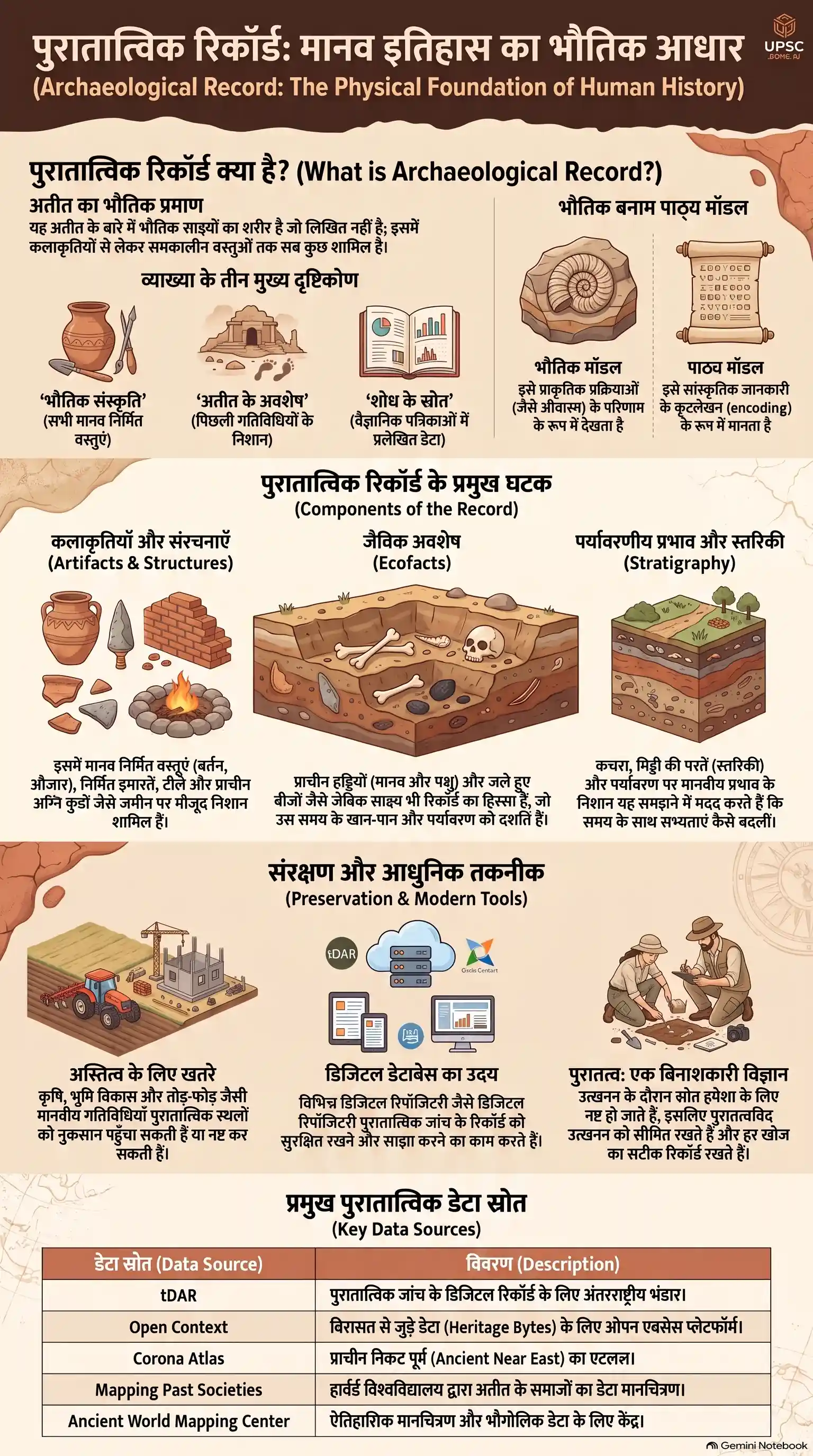
1. The Paradox of Discovery: To Know the Past is to Destroy It
There is a tragic irony at the heart of archaeology: it is fundamentally a "destructive science." Unlike a chemist who can repeat an experiment, an archaeologist can never un-dig a hole. The moment a shovel breaks the soil, the physical context of that site—the precise relationship between a shard of pottery and the layer of earth around it—is altered forever.
As noted in the source material:
"Archaeology can be a destructive science for the finite resources of the archaeological record are lost to excavation."
This paradox forces a profound shift in how we define "the record." Philosophers like Linda Patrik point to a transition from a "physical model"—the site as it exists in the ground—to a "textual model." Because the act of discovery consumes the resource, the meticulously written report eventually becomes the only record left. We trade a physical reality for a textual one. This reality forces modern archaeologists to be deeply conservative, often leaving parts of a site untouched for future generations who may possess better technology and fewer destructive tools.
2. The Great Divide: Why "History" and "The Past" Are Not the Same
If the shovel destroys the site, the pen must resurrect it. This leads us to a fundamental realization: "The Past" and "History" are not synonyms. The Past is the total sum of everything that has ever happened—a vast, unchangeable, and largely inaccessible ocean of events. History, by contrast, is our curated conversation with its ghosts.
As the historian E.H. Carr famously defined it, history is an "unending dialogue between the present and the past." We do not just find history; we build it. Because our "present" concerns are always shifting, our "history" is constantly being rewritten. A society facing a climate crisis will look at the past and see environmental cycles; a society undergoing a social revolution will look at the same record and see a history of class struggle. This makes history a human construction—a living, breathing narrative that reflects our current values as much as it reflects bygone eras.
3. The Original Intellectual Feud: Herodotus vs. Thucydides
The foundation of Western historical thought was forged in a clash of styles between two ancient Greeks who had very different ideas about what our "inquiry" should look like.
Herodotus, the "Father of History," was a wide-eyed traveler who wanted to "preserve human achievements" by documenting everything from local myths to the flavor of Egyptian beer. Thucydides, conversely, was an exiled general who had lived through the gritty reality of the Peloponnesian War. He had no time for myths or divine intervention; he wanted a "roadmap for the future" based on the cold mechanics of power.
The Father of History vs. The First Scientific Historian
Feature | Herodotus | Thucydides |
Scope | Broad; included ethnography, geography, and storytelling. | Narrow; focused strictly on political and military events. |
Causality | Attributed events to divine will, fate, or retribution. | Rejected the divine; focused on human nature and power. |
Method | Relied on oral traditions and "it is said" accounts. | Emphasized eyewitness testimony and rigorous analysis. |
By stripping away the gods, the exiled Thucydides birthed political realism. He believed that because human nature is constant, a scientific analysis of "cause-and-effect" would allow future leaders to predict the behavior of nations.
4. The Secret Logic of Empires: Ibn Khaldun’s 'Asabiyyah'
While Western medieval thought, led by figures like St. Augustine, viewed history as "linear and teleological"—a train on a track moving toward a pre-written destination of Divine Judgment—the 14th-century scholar Ibn Khaldun saw something else: cycles.
Khaldun introduced the concept of 'Asabiyyah, or social cohesion. He argued that history is the story of this "group glue." A nomadic tribe with high 'Asabiyyah eventually overthrows a decadent city and establishes a dynasty. However, as that dynasty prospers, it becomes sedentary and soft; the 'Asabiyyah weakens, and the cycle begins anew as a fresh group with stronger solidarity arrives to take their place. Khaldun’s "cyclical" theory predates modern sociology by centuries and offers a mechanical, rather than mystical, explanation for why empires inevitably fall.
5. Everything is a Record: Why Your Trash is Tomorrow’s Treasure
We often think of the archaeological record as a collection of golden crowns, but the "Material Turn" in scholarship tells a different story. To a modern researcher, "Material Culture" includes everything associated with humanity—especially our garbage.
In the eyes of an archaeologist, "trash" is the most honest evidence we leave behind. Journals can lie; discarded dinner scraps cannot. Consider the "ecofact": we often know what an ancient civilization ate only because they burned their dinner. These burned seeds are preserved by the carbonization process, essentially "fossilizing" a Tuesday night meal from three thousand years ago.
Artifacts: Objects we modify (from stone tools to iPhones).
Ecofacts: Natural objects we use (like those charred seeds).
Features: Non-portable impacts (fire pits or burial mounds).
We are actively creating the archaeological record right now. The story of the human world is written in our discarded plastics and carbon footprints as much as in our digital clouds.
Conclusion: The Dialogue Never Ends
History and archaeology are not merely about "finding" things; they are about the persistent attempt to interpret our shared human heritage. It is a dialogue that never closes because we are the ones holding the other end of the line.
As you move through the world today, consider the "material legacy" you are currently depositing into the earth. If history is a curated conversation with the past, what are you saying to the future? If an archaeologist were to dig up your life a thousand years from today, what story would your "record" tell? The inquiry, it seems, has only just begun.