Complete Union Budget 2026 27 analysis for UPSC covering economy, governance, infrastructure, fiscal deficit and probable mains questions.
The
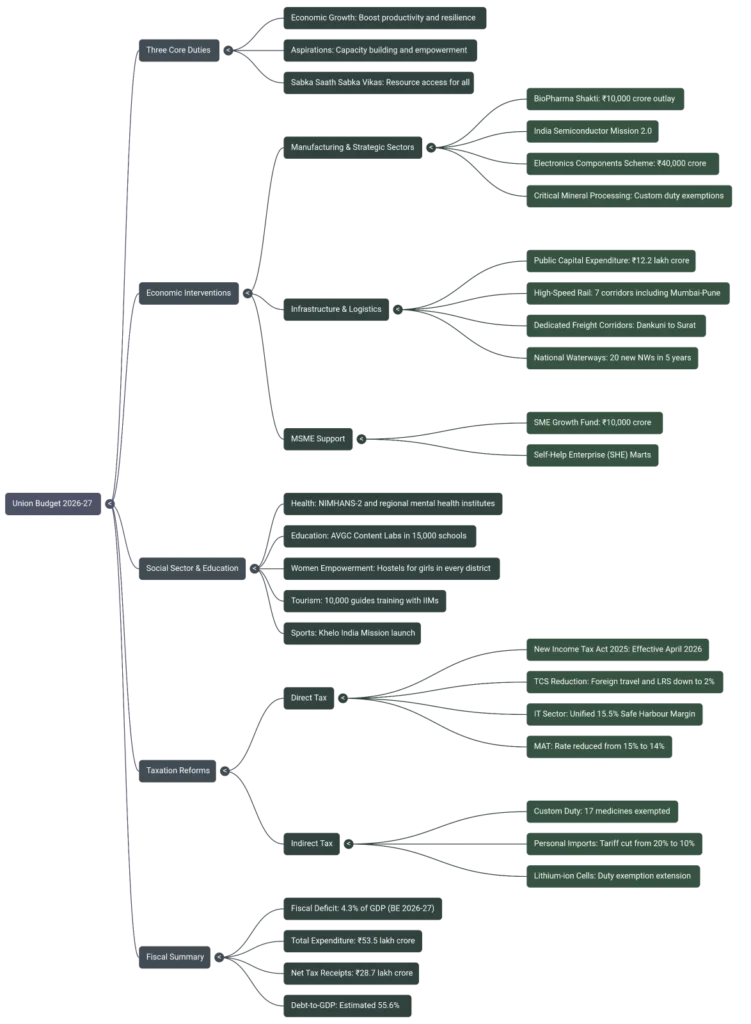
Union Budget 2026 27 is not just a fiscal document; it marks a
conceptual shift in governance as India moves closer to the goal of
Viksit Bharat @2047. Prepared for the first time at
Kartavya Bhavan, the budget reflects a transition from a
rights-centric welfare approach to a
duty-based participatory framework, echoing the Prime Minister’s 2025 Independence Day vision.
The budget builds on over
350 structural reforms undertaken in recent years—covering taxation, labour codes, logistics, digital governance, and manufacturing—and rests on three guiding pillars:
- Accelerated Growth through productivity and resilience
- Aspirational India via capacity building and skill development
- Sabka Saath, Sabka Vikas through inclusive access to resources
GS-II / GS-IV Link: The emphasis on Kartavya (Duties) resonates with Article 51A (Fundamental Duties) and the idea of Constitutional Morality, redefining the citizen–state relationship.
1. Direct Tax Reforms: New Income Tax Act, 2025
(GS-II: Governance | GS-III: Resource Mobilisation)
The Budget announces the rollout of the
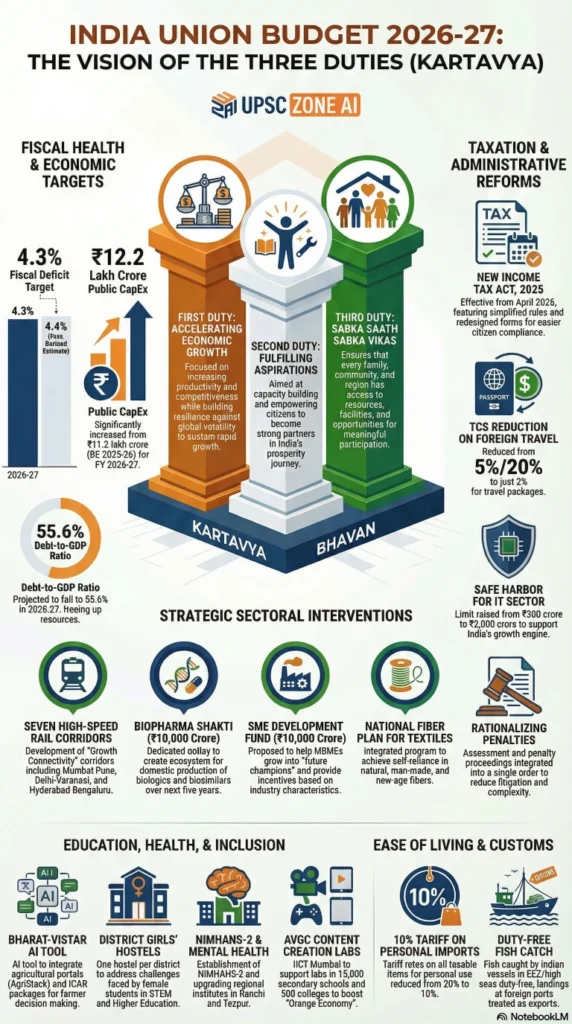
New Income Tax Act, 2025 from April 2026, aimed at simplifying and modernising India’s direct tax framework.
Key Features:
- Simplified compliance: Automated, rule-based systems will replace physical interfaces for low-risk cases.
- Litigation reduction: Assessment and penalty proceedings will now be combined into a single common order, addressing pendency issues.
- TCS Rationalisation:
- Foreign travel packages: reduced to 2%
- Education and medical remittances under LRS: reduced to 2%
- One-time foreign asset disclosure window:
- 6-month opportunity for small taxpayers (students/NRIs)
- No penalty if assets are below a notified threshold
Prelims Angle: Effective date, TCS rates, scope of disclosure window.
[irp]
2. Strategic Manufacturing Push: BioPharma & Semiconductors
(GS-III: Science & Technology | Industrial Policy)
To position India as a
global manufacturing and innovation hub, the budget identifies
strategic frontier sectors.
BioPharma Shakti
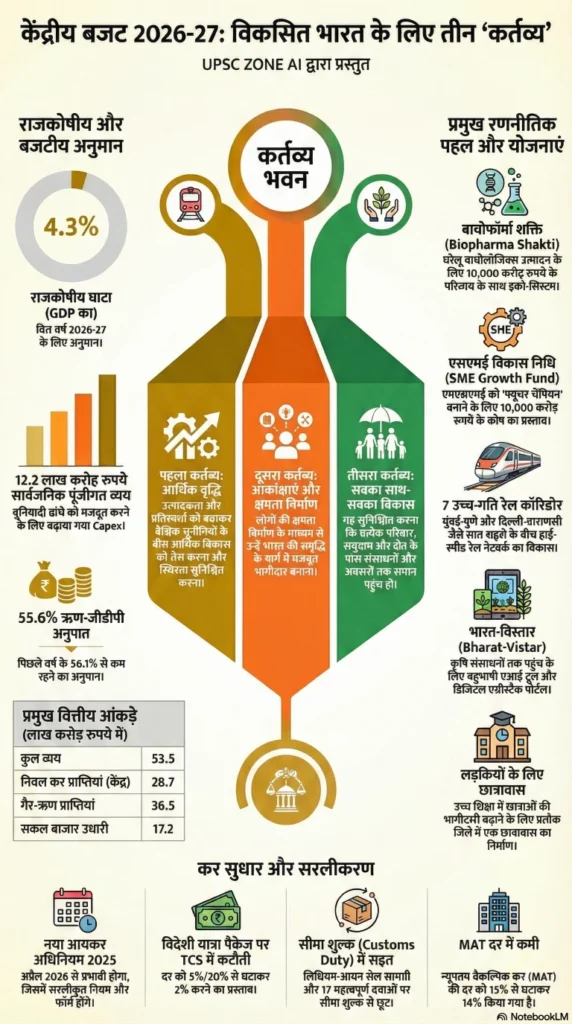
- Outlay of ₹10,000 crore
- Focus on biologics and biosimilars
- Expansion of capacity:
- 3 new NIPERs
- Upgrade of 7 existing NIPERs
- Network of 1,000 clinical trial sites
- CDSCO reforms: Dedicated scientific review cadre to fast-track approvals
India Semiconductor Mission 2.0
- Shift towards full-stack indigenous IP design
- Strengthening supply-chain resilience
- Electronics component manufacturing allocation increased to ₹40,000 crore
IT & Cloud Services
- Tax holiday till 2047 for foreign cloud providers using Indian data centres
- Safe Harbour Margin: Fixed at 15.5%
- Eligibility threshold raised to ₹2,000 crore
Mains Value: Strategic autonomy, Atmanirbhar Bharat, supply-chain geopolitics.
3. Infrastructure 2.0: High-Speed & Multimodal Connectivity
(GS-III: Infrastructure | Logistics)
Public capital expenditure continues to drive growth.
- Capex allocation: ₹12.2 lakh crore (FY 2026–27)
- Vriddhi Transport Corridors:
- 7 high-speed rail routes including Mumbai–Pune, Delhi–Varanasi, Hyderabad–Bengaluru
- Dedicated Freight Corridor Link:
- Dankuni (East) to Surat (West), integrating Eastern and Western DFCs
- Inland Waterways:
- 20 new National Waterways
- Priority to NW-5 (Odisha) linking Talcher–Paradip–Dhamra
- Cargo share target: 12% by 2047 (from 6%)
Prelims Tip: DFC geography, National Waterways numbers.
4. Inclusive Development: Technology-Enabled Social Infrastructure
(GS-II: Social Justice | GS-III: Human Capital)
The budget integrates
technology, gender, and culture into development.
- Bharat-Vistar:
- AI-based multilingual advisory for farmers
- Integrates ICAR packages with AgriStack
- Orange Economy (AVGC):
- Indian Institute of Creative Technology
- Content Creator Labs in 15,000 schools & 500 colleges
- Women Empowerment:
- SHE-Mart: SHG-run community retail outlets
- Girls’ hostels in every district for STEM education
- Rural Economy:
- Mahatma Gandhi Gram Swaraj Initiative
- Linking ODOP with global value chains
- Health:
- Establishment of NIMHANS-2 in North India (mental health focus)
[irp]
5. Fiscal Prudence & Macro Stability
(GS-III: Indian Economy)
The budget advances from deficit control to
debt consolidation.
- Fiscal Deficit: 4.3% of GDP
- Debt-to-GDP Ratio: 55.6%
- MAT Reform:
- Rate reduced from 15% to 14%
- MAT to become a final tax from April 2026
- Toll Manufacturing Boost:
- Safe harbour margin of 15% for non-residents supplying capital goods to bonded manufacturers (5 years)
Answer Enrichment: Debt sustainability, crowding-in of private investment.
Conclusion: Budget as a Constitutional Vision
The
Union Budget 2026 27 positions fiscal policy as an instrument of
citizen responsibility and national participation. By aligning infrastructure expansion with social empowerment and fiscal discipline, it lays the groundwork for a
duty-based developmental state.
🔍 Mains Practice Question
“How does the shift from a rights-based welfare approach to a duty-based (Kartavya) framework reshape the relationship between the Indian State and citizens in achieving Viksit Bharat @2047?”
This question—and this budget—are
highly relevant for UPSC GS-II, GS-III, Essay, and Interview.
🔹 FAQs: Union Budget 2026 27 for UPSC
1. Why is Union Budget 2026 27 important for UPSC preparation?
Union Budget 2026 27 is important for UPSC because it impacts
GS Paper II, GS Paper III, Essay, and Interview. It covers economy, governance reforms, infrastructure, fiscal deficit, and social sector schemes.
2. Which GS papers cover Union Budget 2026 27?
Union Budget 2026 27 is relevant for:
- GS-II: Governance, welfare schemes, constitutional values
- GS-III: Indian economy, infrastructure, agriculture, science & tech
- Essay: Viksit Bharat, inclusive growth, fiscal federalism
3. What is the central theme of Union Budget 2026 27?
The central theme of Union Budget 2026 27 is the shift from a
rights-based welfare model to a duty-based (Kartavya) development framework, aligned with
Viksit Bharat @2047.
4. What are the major economic highlights of Union Budget 2026 27?
Key economic highlights include:
- Fiscal deficit target of 4.3% of GDP
- Capital expenditure of ₹12.2 lakh crore
- Debt-to-GDP ratio reduced to 55.6%
- MAT rate cut to 14%
5. What is the New Income Tax Act, 2025 announced in the budget?
The New Income Tax Act, 2025 aims to simplify tax laws, reduce litigation, introduce automated compliance, and merge assessment and penalty proceedings into a single order.
6. What are the important schemes launched in Union Budget 2026 27?
Important schemes include:
- BioPharma Shakti
- India Semiconductor Mission 2.0
- SHE-Mart for women SHGs
- Bharat-Vistar AI for farmers
- Mahatma Gandhi Gram Swaraj Initiative
[irp]
7. How does Union Budget 2026 27 support infrastructure development?
The budget focuses on:
- High-speed rail corridors under Vriddhi Connectivity
- New Dedicated Freight Corridor (Dankuni–Surat)
- Expansion of National Waterways to boost logistics efficiency
8. What is the relevance of Union Budget 2026 27 for Prelims?
For Prelims, focus on:
- Fiscal deficit and debt figures
- New schemes and missions
- Tax rate changes (TCS, MAT)
- National Waterways and DFC routes
- Semiconductor and biotech initiatives
9. How is Union Budget 2026–27 linked to Viksit Bharat 2047?
The budget aligns fiscal discipline, manufacturing, infrastructure, and human capital development with the long-term goal of transforming India into a
developed nation by 2047.
10. How should UPSC aspirants prepare Union Budget 2026–27?
UPSC aspirants should:
- Link budget points with GS syllabus
- Use data for answer enrichment
- Practice mains questions based on budget themes
- Prepare 1–2 pages of budget short notes
Study Guide: Union Budget 2026 27
This study guide provides a comprehensive overview of the Central Budget for the fiscal year 2026-27, as presented by Union Finance Minister Nirmala Sitharaman. It is structured to facilitate a deep understanding of the government's economic priorities, fiscal targets, and sectoral initiatives.
Part 1: Review Quiz
Instructions: Provide short-answer responses (2-3 sentences each) for the following questions based on the source context.
- What are the "Three Duties" (Kartavyas) that inspired the preparation of this budget?
- What is "BioPharma Shakti" and what are its primary objectives?
- How does the budget aim to support MSMEs as "future champions"?
- Detail the fiscal deficit projections for the years 2025-26 and 2026-27.
- What is the "Bharat-Vistaar" initiative in the agricultural sector?
- How does the budget address the challenges faced by female students in STEM education?
- What significant changes are proposed for Tax Collected at Source (TCS) regarding foreign travel?
- Which seven cities are identified for the development of high-speed rail corridors as "growth connectors"?
- What are the key changes proposed for the Information Technology (IT) sector's "Safe Harbor" regime?
- When will the New Income Tax Act, 2025, become effective, and what is its goal?
Part 2: Answer Key
- The Three Duties: The budget is inspired by three duties: accelerating and sustaining economic growth through productivity and competitiveness; fulfilling the aspirations of the people and building their capacity; and adhering to the vision of "Sabka Saath, Sabka Vikas" to ensure all communities have access to resources and opportunities.
- BioPharma Shakti: This is an initiative with an outlay of ₹10,000 crore over five years to create an ecosystem for the domestic production of biologics and biosimilars. It includes the creation of a biopharma-focused network through new and upgraded National Institutes of Pharmaceutical Education and Research (NIPERs) and 1,000 clinical trial sites.
- MSME Support: The government proposes a ₹10,000 crore SME Development Fund to transform MSMEs into "future champions." Additionally, the Atmanirbhar Bharat Fund, established in 2021, will continue to receive support with an allocation of ₹2,000 crore to assist micro-entrepreneurs.
- Fiscal Deficit Projections: For the Revised Estimate (RE) 2025-26, the fiscal deficit is projected at 4.4% of GDP. For the Budget Estimate (BE) 2026-27, the deficit is expected to decrease slightly to 4.3% of GDP, aligning with the government's fiscal consolidation path.
- Bharat-Vistaar: This is a multilingual AI tool designed as a virtual integrated system for accessing agricultural resources. It integrates the ICAR package and AgriStack portals with AI systems to provide advisory support, reduce risks, and increase agricultural productivity.
- Support for Female STEM Students: Recognizing the challenges of long study and lab hours, the government plans to establish a girls' hostel in every district. This will be achieved through Viability Gap Funding (VGF) or capital support to encourage higher participation in STEM and higher education.
- TCS on Foreign Travel: The budget proposes reducing the current TCS rates on the sale of foreign travel packages from 5% and 20% down to a uniform rate of 2%. This reduction applies without any specific threshold amount to simplify the tax burden on travelers.
- High-Speed Rail Corridors: Seven corridors will be developed: Mumbai-Pune, Pune-Hyderabad, Hyderabad-Bengaluru, Hyderabad-Chennai, Chennai-Bengaluru, Delhi-Varanasi, and Varanasi-Siliguri. These are intended to promote environmentally sustainable passenger systems and act as growth connectors between cities.
- IT Safe Harbor Changes: The budget proposes a single category for IT services with a uniform 15.5% Safe Harbor margin. Furthermore, the threshold for eligibility for the Safe Harbor facility is significantly increased from ₹300 crore to ₹2,000 crore.
- New Income Tax Act, 2025: The New Income Tax Act, 2025, is scheduled to become effective starting April 1, 2026. Its primary goal is to provide a simplified tax code with redesigned forms and rules that common citizens can comply with easily and without difficulty.
Part 3: Essay Questions
Instructions: Use the following questions to guide in-depth analysis or discussion. No answers are provided for this section.
- Analyze the "Duty-Driven" Framework: How do the three central duties (Kartavyas) reflect a shift in India's budgetary philosophy compared to traditional economic planning?
- Infrastructure and Connectivity: Evaluate the strategic importance of the proposed new freight corridors, national waterways, and high-speed rail networks in achieving the goal of a "Developed India" by 2047.
- Taxation as a Tool for Ease of Living: Discuss how the proposed changes in the New Income Tax Act, 2025, and the rationalization of customs duties (such as for medicines and personal imports) aim to improve the "Ease of Living" for Indian citizens.
- Global Integration and Investment: Examine the measures taken in the 2026-27 budget to attract global capital and cloud service providers, specifically focusing on tax holidays and safe harbor provisions for non-residents.
- Human Capital and Social Inclusion: Critically assess the budget's focus on "Youth Power" and "Sabka Saath, Sabka Vikas" through its initiatives in education (hostels), sports (Khel India Mission), and mental health (NIMHANS-2).
Part 4: Glossary of Key Terms
| Term |
Definition |
| AEO (Authorized Economic Operator) |
A program where Tier 2 and Tier 3 operators receive preferential treatment and extended duty deferment (increased from 15 to 30 days) to facilitate smoother cargo movement. |
| APA (Advance Pricing Agreement) |
A procedural agreement between a taxpayer and tax authority; the budget aims to speed up unilateral APA processes for IT companies to within two years. |
| BioPharma Shakti |
A ₹10,000 crore initiative aimed at boosting domestic manufacturing of biologics and biosimilars to make India a global biopharma hub. |
| Budget Estimate (BE) |
The projected amount of revenue and expenditure for the upcoming fiscal year (e.g., 2026-27). |
| Capital Expenditure |
Funds used by the government to acquire, upgrade, and maintain physical assets; projected at ₹12.2 lakh crore for FY 2026-27. |
| Customs Integrated System (CIS) |
A single, unified, and scalable platform for all customs processes planned to be launched within two years. |
| Fiscal Deficit |
The difference between the government's total expenditure and its total non-debt receipts; projected at 4.3% of GDP for 2026-27. |
| Khel India Mission |
A mission designed to transform the sports sector over the next decade through talent development, sports science integration, and infrastructure growth. |
| MAT (Minimum Alternative Tax) |
A tax aimed at companies that report high profits but pay low tax due to exemptions; the budget proposes a reduction in the MAT rate from 15% to 14%. |
| NIMHANS-2 |
A newly proposed mental health institution for North India, signaling a commitment to expanding trauma care and mental health services. |
| Revised Estimate (RE) |
A mid-year review of the current fiscal year's budget (e.g., 2025-26) to reflect actual spending and revenue. |
| Safe Harbor Margin |
A provision that simplifies transfer pricing for taxpayers; for IT services, a uniform 15.5% margin is proposed for those under a ₹2,000 crore limit. |
| STT (Securities Transaction Tax) |
A tax on transactions involving various securities; the rate for futures and options is proposed to be increased in this budget. |
| TCS (Tax Collected at Source) |
An extra tax collected by a seller from a buyer at the time of sale, later remitted to the government; notably reduced for foreign travel in this budget. |
| VGF (Viability Gap Funding) |
Financial support provided by the government for infrastructure projects that are economically justified but fall short of financial profitability. |
Keywords UPSC budget analysis 2026, Budget 2026 27 prelims notes, union Budget 2026 27 mains answer, Union Budget UPSC GS 2, Union Budget UPSC GS 3, fiscal deficit budget 2026, capital expenditure budget 2026, duty based governance kartavya, viksit bharat 2047 budget, income tax reform budget 2026, semiconductor mission 2.0,