The Battle of Talikota (1565): Causes, Events, and the Fall of Vijayanagara Empire
The Battle of Talikota, fought on 23 January 1565, was one of the most significant battles in medieval Indian history. It marked a major turning point in the history of South India and severely weakened the powerful Vijayanagara Empire.
The battle was fought between the Vijayanagara forces, led by Aliya Rama Raya, and an alliance of Deccan Sultanates. The defeat of Vijayanagara was followed by the sack of its magnificent capital, Hampi, which had been an important centre of political power, trade, architecture, and culture.
In this article, we will explore the causes, major events, important personalities, and consequences of the Battle of Talikota, along with its significance for UPSC and other competitive examinations.
What Was the Battle of Talikota?
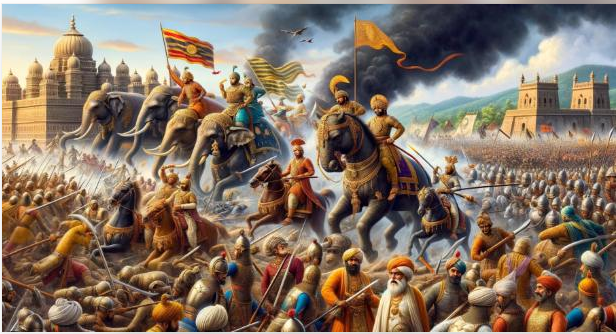
The Battle of Talikota was a major military confrontation between the Vijayanagara Empire and a coalition of Deccan Sultanates.
It is also associated with the name Battle of Rakshasa-Tangadi, referring to the area traditionally linked with the battlefield.
The Vijayanagara Empire was one of the most powerful kingdoms in South India. During the sixteenth century, it controlled extensive territories and supported flourishing agriculture, international trade, temple construction, and artistic traditions.
The battle took place during the rule of Sadashiva Raya, although much of the empire's effective political and military authority was exercised by his regent, Aliya Rama Raya.
Date: 23 January 1565
Main opposing sides: Vijayanagara Empire and the Deccan Sultanates
Important Vijayanagara leader: Aliya Rama Raya
Major consequence: The defeat of Vijayanagara and the subsequent destruction of much of its capital.
Background of the Vijayanagara Empire
The Vijayanagara Empire was founded in 1336 by Harihara I and Bukka Raya I, traditionally associated with the Sangama dynasty.
Its capital, Vijayanagara, near present-day Hampi in Karnataka, became a major political, commercial, and cultural centre.
The empire reached considerable power under rulers such as Deva Raya II and Krishnadevaraya. During Krishnadevaraya's reign (1509–1529), Vijayanagara achieved notable military successes and experienced significant cultural and economic development.
After Krishnadevaraya's death, succession disputes and changing political alliances complicated the empire's affairs. Aliya Rama Raya emerged as a dominant political figure and played a major role in relations with the neighbouring Deccan Sultanates.
Causes of the Battle of Talikota
Several political and military factors contributed to the conflict.
A. Political rivalry in the Deccan
The Deccan region was divided among several Sultanates, including Ahmadnagar, Bijapur, Golconda, and Bidar. These states frequently competed with one another for territory and influence.
Vijayanagara also participated in these rivalries, sometimes supporting one Sultanate against another.
B. The policies of Aliya Rama Raya
Aliya Rama Raya pursued an active diplomatic and military policy in the Deccan. His interventions helped Vijayanagara maintain influence, but they also generated hostility among neighbouring rulers.
His shifting alliances and attempts to exploit divisions among the Sultanates contributed to the formation of a coalition against Vijayanagara.
C. Formation of the Deccan alliance
The rulers of several Deccan Sultanates united against Vijayanagara. The principal powers associated with the coalition were Ahmadnagar, Bijapur, Golconda, and Bidar.
Their cooperation created a formidable challenge for Rama Raya's forces.
D. Strategic and military factors
The conflict involved more than political rivalry. Military organisation, battlefield decisions, coordination between allied armies, and the use of cavalry and firearms all influenced the outcome.
The coalition's ability to combine its forces proved decisive in the confrontation.
Major Leaders Involved
Aliya Rama Raya
Aliya Rama Raya was the dominant political figure in Vijayanagara during the reign of Sadashiva Raya. He exercised considerable authority over the empire's military and diplomatic affairs.
His defeat and capture during the battle became a decisive moment in Vijayanagara's fortunes.
Husain Nizam Shah I
Husain Nizam Shah I was the ruler of Ahmadnagar and an important figure in the coalition against Vijayanagara.
Ali Adil Shah I
Ali Adil Shah I ruled Bijapur and was another major participant in the Deccan alliance.
Ibrahim Qutb Shah
Ibrahim Qutb Shah, ruler of Golconda, was associated with the coalition that fought Vijayanagara.
The Sultanate of Bidar also formed part of the broader alliance.
What Happened During the Battle?
The battle took place in January 1565, with the forces of Vijayanagara confronting the allied armies of the Deccan Sultanates.
The Vijayanagara army initially possessed considerable military strength. However, the allied forces coordinated their operations and brought their combined resources to bear against Rama Raya's army.
A decisive development was the capture of Aliya Rama Raya. He was subsequently killed, and his death severely disrupted the leadership of the Vijayanagara forces.
The resulting confusion and collapse of command contributed to the defeat of the imperial army.
Following the victory, the allied forces advanced towards Vijayanagara. The capital suffered extensive looting and destruction, and its political and economic importance was greatly diminished.
The precise details of some battlefield events vary across historical accounts, so individual tactical explanations should be treated with care.
Consequences of the Battle of Talikota
A. Destruction of Vijayanagara's capital
The sack of Vijayanagara was among the most devastating consequences of the defeat. Much of the city's built environment was damaged or destroyed.
Hampi's surviving temples, monuments, market streets, and royal structures provide evidence of the scale and sophistication of the former capital.
B. Decline of central imperial authority
The defeat weakened the central power of the Vijayanagara Empire. Its rulers continued to exercise authority in parts of South India, but the empire never recovered its former political dominance.
C. Shifting political balance in the Deccan
The battle altered the regional balance of power. The Deccan Sultanates had dealt a major blow to their powerful southern rival, although their own rivalries continued afterwards.
D. Movement of the imperial centre
The surviving Vijayanagara leadership continued under the Aravidu dynasty. The court operated from other centres, including Penukonda and later Chandragiri, as political circumstances changed.
E. Long-term regional changes
The weakening of Vijayanagara affected the political relationships of South India. Regional Nayaka powers, including those associated with Madurai, Thanjavur, and other territories, gained greater autonomy over time.
The process was gradual, however, rather than an immediate disappearance of all Vijayanagara authority in 1565.
Was the Battle of Talikota the End of the Vijayanagara Empire?
The Battle of Talikota is often described as the beginning of the end of the Vijayanagara Empire. However, it is historically inaccurate to say that the empire disappeared immediately after the battle.
Although the capital was devastated and central authority was severely weakened, the Vijayanagara state survived under the Aravidu dynasty for several more decades.
Its political influence gradually declined amid regional conflicts, succession problems, and the growing independence of subordinate rulers.
Therefore, 1565 marked a decisive turning point rather than the immediate end of the Vijayanagara Empire.
8. Historical Significance of the Battle
The Battle of Talikota is important for understanding the political history of medieval South India.
It demonstrated the consequences of shifting alliances and regional rivalries.
It weakened one of the most powerful political states in southern India.
It transformed the political landscape of the Deccan and South India.
It marked a major rupture in the history of Vijayanagara's capital.
It provides an important case study of warfare, diplomacy, and state formation in medieval India.
The battle also highlights the need to distinguish between the destruction of a capital city and the disappearance of the political state associated with it.
Battle of Talikota: Important Facts for UPSC
Topic | Key fact |
|---|---|
Year of the battle | 1565 |
Commonly cited date | 23 January 1565 |
Alternative name | Battle of Rakshasa-Tangadi |
Vijayanagara leader | Aliya Rama Raya |
Nominal ruler | Sadashiva Raya |
Opponents | Alliance of Deccan Sultanates |
Major Sultanates involved | Ahmadnagar, Bijapur, Golconda and Bidar |
Major immediate consequence | Defeat of Vijayanagara and sack of its capital |
Later ruling dynasty | Aravidu dynasty |
UPSC Prelims Practice Question
Q. Consider the following statements about the Battle of Talikota:
It was fought in 1565.
Aliya Rama Raya was a key leader of Vijayanagara.
The defeat resulted in the immediate and complete disappearance of the Vijayanagara state.
Which of the statements given above are correct?
A. 1 and 2 only
B. 2 and 3 only
C. 1 and 3 only
D. 1, 2 and 3
Correct Answer: A. 1 and 2 only
Explanation: The battle took place in 1565, and Aliya Rama Raya was the dominant political and military figure on the Vijayanagara side. The state survived under the Aravidu dynasty after the defeat.
Conclusion
The Battle of Talikota was a turning point in medieval Indian history. The defeat of Aliya Rama Raya's forces in 1565, followed by the sack of Vijayanagara, severely weakened the empire and transformed the political landscape of South India.
Yet the empire did not vanish overnight. Its later rulers continued to govern from other centres, while regional powers gradually asserted greater independence.
For UPSC aspirants, the battle is especially important for understanding the political rivalries, military developments, and changing power structures of medieval India.